Why fitting matters more here than the brochure suggests
Double brick houses from the 1940s and 50s move over eighty years. Corners are out of square by five or ten millimetres, floors fall toward the back door, and rendered walls bow in the middle. Cabinetry that is simply pushed into that gap leaves a wedge of shadow at one end.
The fix is unglamorous: filler panels scribed to the wall, adjustable legs levelled to the floor rather than to the wall, and a finishing panel at the end of a run rather than a raw carcass edge. It is a couple of extra hours on site and it is the difference between a kitchen that looks made for the room and one that looks delivered to it.
Carcass, doors and hardware are three separate decisions
Carcass. Moisture-resistant particleboard is the default and performs well when edges are properly sealed, particularly under the sink. Plywood costs more, weighs less and holds fixings better, which matters for tall units and heavy stone.
Doors. The visible half of the job. Laminate, thermolaminated vinyl, two-pack polyurethane, timber veneer and solid timber all behave differently around heat, steam and small children. Compared properly in cabinet door finishes.
Hardware. Hinges and runners are where a cheap kitchen gives itself away within two years. Soft-close runners rated for the drawer width, full-extension where you need to see the back, and hinges with adjustment in three directions.
What we build most often
- Deep pot drawers under the cooktop, two high rather than three, with a shallow utensil drawer above.
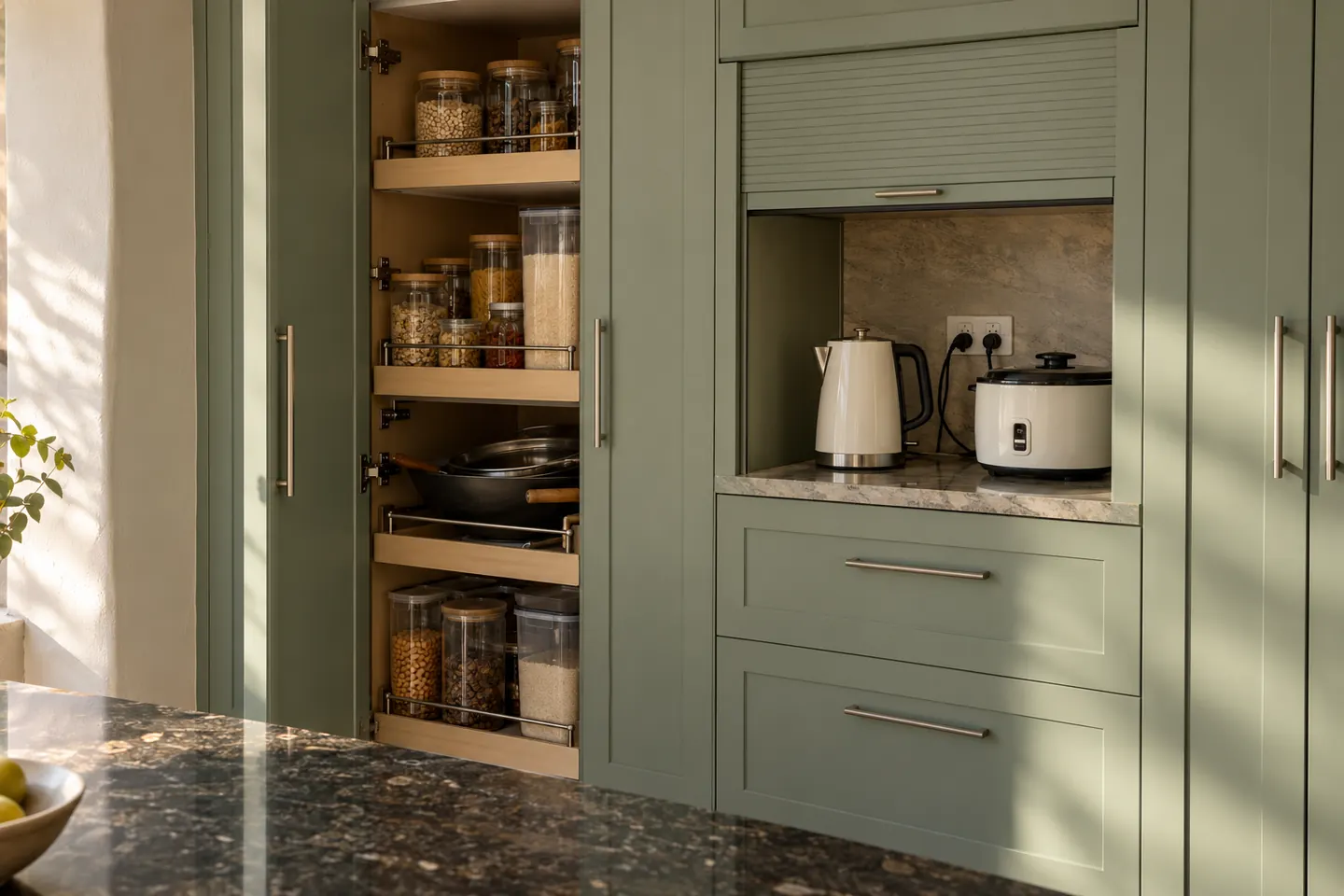
- Tall pantry units with internal pull-outs, so you see the whole shelf at once.
- Appliance cupboards with a power point inside and a roller door or a lift-up, so the kettle, rice cooker and air fryer live off the bench.
- Corner solutions — a proper corner drawer system, or a blank panel where the geometry does not justify the hardware.
- Overhead cupboards to the ceiling, with the top shelf for the things you use twice a year, instead of a dust ledge above the doors.
- Bin drawers beside the sink, split for rubbish and recycling.
- A dedicated wok kitchen fit-out where the cooking moves out the back. See second and wok kitchens.
Units and tight access
In the walk-ups and towers around Hurstville station, cabinetry often has to come up in a lift, in pieces, within a booked window. Carcasses get broken into liftable modules and assembled in the apartment. That is a design decision made at the drawing stage, not a problem discovered on delivery day. See apartment and strata kitchens.
How cabinetry appears on the quote
Cabinetry is priced as its own line, separate from the benchtop, the splashback and the trades. Within it, you can see what the door finish, the drawer count and the internal hardware each contribute, which makes it the easiest part of a kitchen to tune to a budget. See the 2026 cost guide and layout and design.
Call 02 4404 0245 or send your kitchen details through.
More kitchen work
Questions people ask before they commit
What are kitchen cabinets actually made from?
The carcass is usually moisture-resistant particleboard or plywood; plywood is lighter and holds screws better, and costs more. Doors are a separate decision — laminate, thermolaminated vinyl, two-pack polyurethane, timber veneer or solid timber. The door finish is what you see and touch, so it is worth reading up on separately.
Are drawers really better than cupboards?
For base cabinets, yes. A drawer brings its whole contents to you, so nothing is lost at the back, and modern runners handle heavy pots easily. Cupboards still make sense for tall pantry units, appliance cupboards and anything you store upright.
Can you match new cabinetry to an existing kitchen?
Sometimes closely, rarely perfectly. Laminate and vinyl decors are discontinued and replaced regularly, and timber and paint both change colour with age and light. Where an exact match matters, it is usually better to replace the doors across the whole run.
How long does cabinetry take to make?
Commonly three to five weeks from the day selections are signed off, depending on the door finish. Two-pack polyurethane takes longest because it is sprayed and cured. That manufacturing time happens while you are still using the old kitchen.